 how-to
How to Choose Corm Grown Alocasia Plants
Table of Contents
- Why Corm Grown Alocasia Plants Are Worth Seeking Out
- Corm Grown vs Tissue Culture Alocasia: What You're Actually Buying
- Reading the Corm: Size, Firmness and Tunic
- Alocasia Corm Propagation Tips for Home Growers
- The Best Potting Mix for Alocasia Corms and Juveniles
- Acclimatising Rare Aroids After They Arrive in the Post
- Questions to Ask Before You Buy Corm Grown Alocasia Online
- Conclusion: Choosing Plants You'll Still Love in a Year
- Frequently Asked Questions
Last Updated: October 4, 2026
Why Corm Grown Alocasia Plants Are Worth Seeking Out
If you have ever bought a rare Alocasia online and watched it sulk, drop every leaf, or quietly rot away, the plant's origin may be the reason.
A corm-grown Alocasia is raised from a corm: the starchy storage bulb at the base of the plant.

Tissue culture plants are cloned in a lab from tiny pieces of plant tissue, then deflasked and grown on.
Corm Grown vs Tissue Culture Alocasia: What You're Actually Buying
Corm-grown and tissue culture plants are both legitimate ways to produce Alocasia.
A corm-grown plant was propagated from a bulb, growing roots in potting mix, real air and real light.
A tissue culture plant was cloned in a sterile lab, spent its early life in a jar of gel, then was deflasked and hardened off.
Neither method is "bad". But if you are paying collector prices for a rare variegated plant, you deserve to know which one you are buying.
How to Tell a Corm-Grown Plant from a TC Plant
Ask the seller directly and expect a clear answer. A corm-grown plant should be described as exactly that, with no vague wording.
Look for these signals:
- The listing says "corm grown" in plain language
- The seller shows the corm or base of the plant in photos
- The plant has a visible, firm base with a tunic
- Roots are established and hold the mix together
If a listing only says "rare" or "collector" without naming the propagation method, treat that as a question to ask, not an answer.
Reading the Corm: Size, Firmness and Tunic
A healthy corm feels firm and heavy for its size, with a dry papery tunic and no soft or mushy spots.
Size tells you about stored energy: a larger corm has more reserves to push out that first leaf and root system, while a tiny corm has less margin for error.
Things to check:
- Firm, not soft or spongy
- No dark, translucent or foul-smelling patches
- No active fungal growth or mould
- Tunic dry, not slimy
Alocasia Corm Propagation Tips for Home Growers
You can sprout a corm at home with very little equipment. The key is warmth, moisture and patience, in that order, most failures come from rushing one of those three, not bad luck.
Start with a clean corm: rinse off any mix or debris, check again for soft spots, and if you find any, trim back to firm tissue with a clean blade and let the cut dry for a day.
Then pick your method. The puddle method is popular for a reason: it is simple and you can watch progress.
The Puddle Method and Other Ways to Wake a Corm
The puddle method uses a small closed container, a shallow pool of water, and warmth. The corm sits above the water, not in it.
How to do it:
- Take a clean deli or takeout container with a lid.
- Add a shallow layer of water, just a few millimetres.
- Rest the corm on a small piece of perlite or a bottle cap so it sits above the water.
- Close the lid to hold humidity.
- Place it somewhere warm with indirect light.
- Open the lid every few days to swap the air.
- Watch for a root nub, then a shoot.
Other methods work too: sit a corm in damp sphagnum moss, or lay it on a bed of damp perlite.
The rule across all methods: moist, never wet. A corm sitting in standing water will rot.
Why Corms Fail (and What to Do About It)
In practice, corms that fail tend to fail in one of four ways, each with a different cause.
Firm corm, no roots, no shoot after several weeks. Usually a warmth problem.
White fuzz on the corm. A little surface mould on the tunic is common in a closed container and not automatically fatal.
Root nub forms, then stalls. The corm has committed to growing but the environment is too dry or cool.
Species and Variety Differences Worth Knowing
Not every Alocasia corm behaves the same way, and this is where a lot of home growers get caught out.
Jewel Alocasias, smaller, iridescent-leaved types like Alocasia cuprea, A. melo and A. azlanii, have smaller corms with less stored energy.
Bigger species such as Alocasia zebrina, A. macrorrhizos and A. portora produce chunky corms with serious reserves.
Variegated Alocasias add another layer.
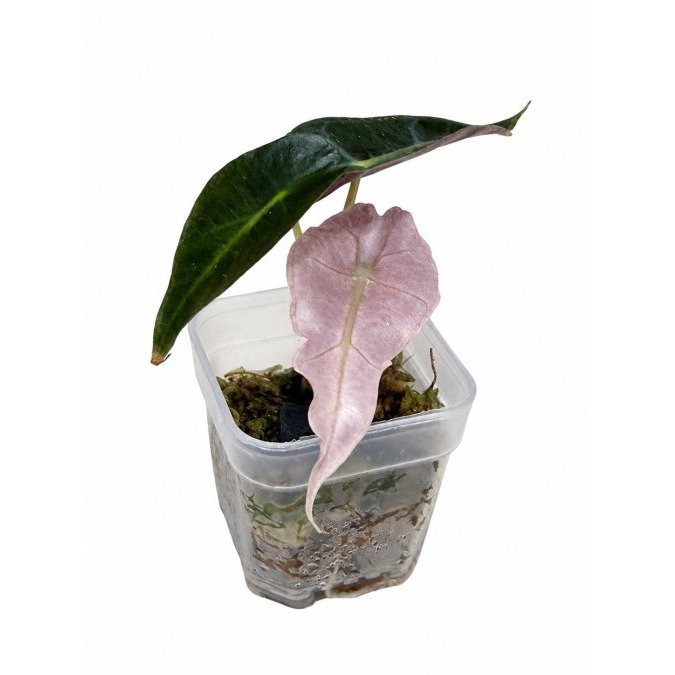
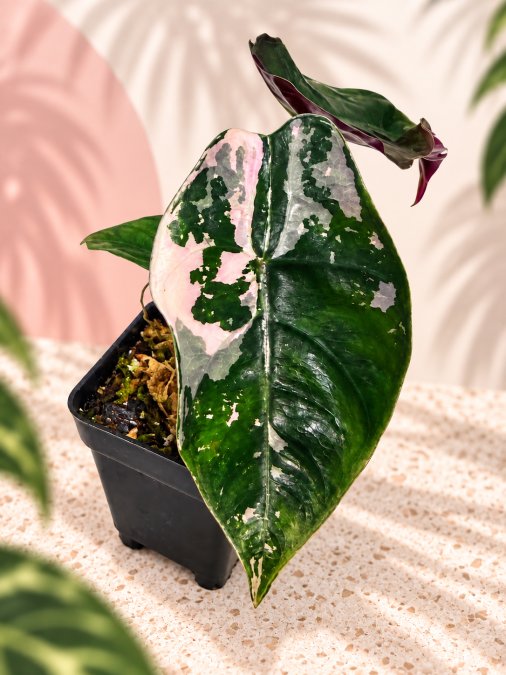
🌿 Alocasia Pink Dragon Albo Variegated – Corm Grown | NOT TC | Exact Plant →
Dormancy matters too.
The Best Potting Mix for Alocasia Corms and Juveniles
Alocasia roots want a chunky, airy mix, bark, perlite and a little coco coir, not dense, water-holding potting soil.
Once your corm has roots and a shoot, it is ready for mix.
A simple mix that works well:
- 40% orchid bark
- 30% perlite
- 20% coco coir
- 10% worm castings or similar
Pot it small. A juvenile plant in a huge pot sits in wet mix it cannot use.
Water when the top of the mix starts to dry. In warm weather that might be every few days.
Acclimatising Rare Aroids After They Arrive in the Post
A plant that has just travelled in a box needs a soft landing.
Do not repot straight away unless the mix is clearly wrong, do not feed it, and do not move it around chasing the perfect spot. Let it settle.
What to do on arrival:
- Unbox gently and remove packing moss
- Check the corm and roots for damage
- Water only if the mix is dry
- Place in bright, indirect light
Some leaf drop after shipping is normal. A corm-grown plant with a strong base usually pushes new growth once it settles.
Questions to Ask Before You Buy Corm Grown Alocasia Online
Ask about propagation method, the corm itself and how the seller ships. A seller who grows their own plants will answer all three without hesitation.
The questions that matter most, and what to listen for:
- Was this plant grown from a corm or tissue culture? A clear answer names the method. Vague wording like "grown from our stock" or "nursery propagated" is not an answer. If the seller cannot tell you, assume you do not know what you are buying.
- Can you show me the corm or base in a photo? A corm-grown plant should have a visible, firm base with a tunic. If the listing only shows leaves, ask for a base shot. A seller who grows their own plants can usually take one.
- Is the plant established and rooted? You want roots that hold the mix together, not a freshly pulled division. An established plant has already handled one change of environment.
- How do you pack plants for shipping? The answer should mention bare-root or moss-wrapped, secure in the box, with the pot removed or the mix held in place. Loose plants rattling around in a box arrive stressed.
- What happens if it arrives damaged? A seller with a clear process will tell you what to do and how quickly to do it. If the answer is vague, that tells you something.
You can also ask about variegation stability. Any honest seller will tell you the same thing: variegation can increase, decrease or change with each new leaf. No one can promise it stays the same.
Reading a Listing Like a Collector
A good corm-grown listing shows the plant you are buying, not a stock photo of the species. Look for individual plant photos, a visible base or corm, and a description that names the propagation method in plain language.
Red flags worth pausing on:
- Stock photos only, no individual plant shots
- No mention of propagation method anywhere in the listing
- Prices that seem out of step with the size and stage of the plant
- No information about how the plant will be packed
- A seller who will not answer a direct question about the corm
None of these are automatic dealbreakers on their own, but two or three together usually mean the seller is reselling rather than growing.
Timing Your Purchase Around the Seasons
Alocasias respond to warmth and light, and so does the shipping experience.
In the cooler months, many Alocasias slow down or go dormant.
At Obsessed With Aroids, we list exact plants with photos, so you see the plant you are buying. Our corm-grown Alocasia, like our Alocasia Pink Dragon Albo Variegated, are grown from corms, not tissue culture, and shipped in moss with care.

For biosecurity and interstate plant movement, check the current requirements with the Australian Department of Agriculture, Fisheries and Forestry before you order from any seller.
If you want to read more about how we grow and ship, our [plant care information | obsessedwitharoids.com] covers the basics.
Conclusion: Choosing Plants You'll Still Love in a Year
The plant you choose today is the one you will live with for years.
A corm-grown Alocasia gives you a head start: real roots, real reserves, and a plant that has already handled change once. That is worth seeking out.

At Obsessed With Aroids, we grow corm-grown collector Alocasia and Anthurium, list exact plants with honest photos, and ship carefully packed in moss.
Frequently Asked Questions
How can you tell if an Alocasia was grown from a corm?
Corm-grown plants usually show a rounded, slightly bulbous base where the original corm sits just above or at soil level. You may also see the dry, papery tunic still attached, and the plant tends to have fewer, sturdier leaves rather than a dense cluster of uniform growth. Tissue-cultured plants often arrive as very uniform, tightly clumped juveniles with no visible corm base. Ask the seller directly and look for listings that state corm grown and show the exact plant.
What are the benefits of choosing corm grown Alocasia over tissue culture?
Corm-grown plants are raised from the plant's own offsets, so each one is genetically unique and keeps the character of the parent, including variegation patterns. Tissue culture produces many identical copies, which can be uniform but sometimes throws off weak or unstable growth. For collectors chasing rare, variegated Alocasia, corm-grown stock is generally an interesting and reliable long-term choice, and it tends to transition into home conditions.
Does Alocasia corm size matter when selecting a plant?
Yes, it matters. A larger, firm corm has more stored energy, which usually means faster leaf emergence and a better chance of pushing multiple growth points. Small, shrivelled or soft corms often stall or rot before they sprout. When buying an established juvenile, feel the base if you can: it should be dense and heavy for its size. Size alone is not everything, though, since a healthy medium corm beats a large damaged one every time.
What is the best potting mix for Alocasia corms?
A chunky, airy mix works best. Combine orchid bark, perlite and a small amount of coco peat or peat moss so water drains freely but still holds some moisture. Sphagnum moss alone is fine for the early sprouting stage in a closed container, but once roots and leaves appear, move the plant into a proper mix. Avoid heavy, water-retentive potting soil, which keeps the corm too wet and invites rot.
Choosing a rare Alocasia is exciting, but the wrong plant can mean months of frustration. At Obsessed With Aroids, we grow corm-grown collector plants, list exact plants with honest photos, and pack every order in moss for safe travel. Browse our rare Alocasia and Anthurium collection and start with a plant that is built to thrive.