 how-to
Care for Rare Variegated Alocasia: A Collector's Guide
Table of Contents
- Why Variegated Alocasia Demands Different Care
- Light Requirements for Variegated Alocasia
- How to Water Alocasia Without Causing Root Rot
- Alocasia Soil Mix and Root Health
- Humidity, Temperature and Seasonal Feeding
- Variegated Alocasia Frydek Care: Keeping Patterns Stable
- How to Acclimate Alocasia After Arrival
- Troubleshooting Common Issues
- Frequently Asked Questions
Last Updated: October 16, 2026
Why Variegated Alocasia Demands Different Care
Variegated Alocasia are stunning but temperamental. Their white, cream or yellow sections contain little to no chlorophyll, so they need brighter conditions than solid-green varieties and revert more readily when light drops or stress builds.
At Obsessed With Aroids, we see the same pattern: treat a variegated plant like a standard Alocasia and you get fading patterns or stunted growth.
Once you understand what they need, variegated Alocasia care becomes straightforward, not fragile, just specific. This guide covers keeping variegation stable, preventing common failures, and settling your plant in after arrival.
Light Requirements for Variegated Alocasia
Variegated Alocasia needs bright indirect light for at least 12-14 hours daily to maintain colour and support active growth.
Place it near a north- or east-facing window with strong morning or afternoon light but no direct sun, or use a grow light 30-45 cm above the plant for 12-14 hours daily.
Watch for these light-related problems:
- Leaves turning solid green (reverting), light is too low
- New leaves smaller than older ones, insufficient brightness for energy production
- Pale or faded variegation, the plant is stressed and pulling resources from patterned areas
- Slow or no new growth, not enough light to support active development
Rotate every 2-3 weeks so all sides receive even light and variegation stays balanced.
How to Water Alocasia Without Causing Root Rot
Root rot is the number-one killer of variegated Alocasia. They hate waterlogged soil but dislike drying out completely, aim for evenly moist.
Push your finger 2-3 cm into the soil. If it feels damp, wait a few days; if it feels dry at that depth, water thoroughly until it drains from the base.
In spring and summer, water every 5-7 days depending on pot size, humidity and light; in autumn and winter, growth slows, so water every 10-14 days.
Use room-temperature water and water slowly until it flows from the drainage holes, so the whole root ball gets moisture and salts flush out.
Common watering mistakes:
- Watering on a fixed schedule instead of checking soil first
- Using cold water, which stresses tropical plants
- Allowing pots to sit in saucers of standing water
- Watering lightly and frequently (creates shallow, weak roots)
Alocasia Soil Mix and Root Health
The right soil makes or breaks variegated Alocasia care. Standard potting soil compacts and suffocates roots, Alocasia need airy, chunky, well-draining mixes.
Build a mix using these components:
- 40% high-quality potting soil or coco coir
- 30% perlite (for aeration)
- 20% pine bark or orchid bark (adds structure and air pockets)
- 10% worm castings or compost (gentle nutrients)
This drains quickly while holding enough moisture between waterings, and the chunky texture keeps roots healthy.
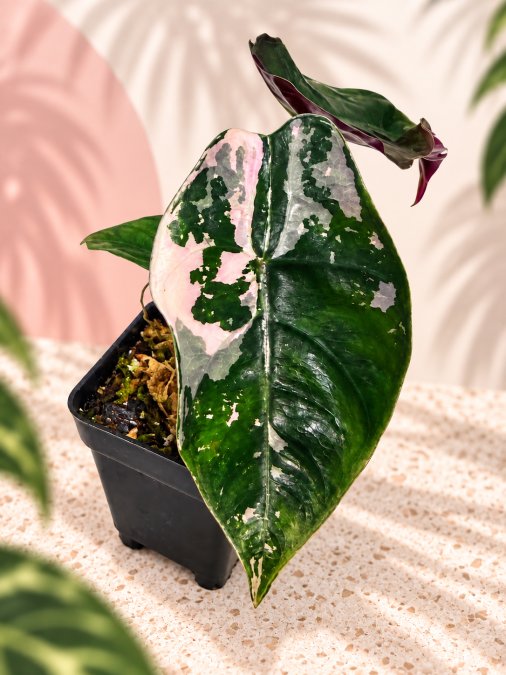
Repot every 12-18 months in spring, into a pot only 2-3 cm wider than the current one, oversized pots trap moisture and increase root rot risk. Always use pots with drainage holes.
If your plant is in dense soil now, repot sooner rather than later, healthy roots are the foundation for stable variegation.
| Component | Purpose | Percentage |
|---|---|---|
| Potting soil or coco coir | Base moisture retention | 40% |
| Perlite | Drainage and aeration | 30% |
| Pine or orchid bark | Structure and air pockets | 20% |
| Worm castings or compost | Gentle nutrition | 10% |
Humidity, Temperature and Seasonal Feeding
Variegated Alocasia thrive in warm, humid conditions, aim for 18-28°C and humidity around 60-80%.
If your home is dry, especially in winter, raise humidity by grouping plants, using pebble-and-water trays (keep pots above water level), misting every 2-3 days, or running a humidifier.
Avoid cold draughts from windows or air conditioning vents, cold stress slows growth dramatically.
Feed during active growth (spring through early autumn) with a balanced, diluted fertiliser, half-strength every 2-4 weeks, or full-strength monthly if your product recommends it. We recommend GT Growth Technology nutrients, formulated for Alocasia and Anthurium to support variegation and vigorous leaf development.
Reduce feeding in autumn and stop entirely in winter, feeding dormant plants wastes nutrients and can burn roots.
Variegated Alocasia Frydek Care: Keeping Patterns Stable
Frydek is the variegated Alocasia most collectors start with, compact, velvety deep-green leaves with white or cream veining, and more forgiving than rarer cultivars.
There are three patterns you'll commonly see sold as variegated Frydek:
- Vein variegation, white or cream runs along the primary veins while the leaf blade stays green. This is the most stable form and the easiest to keep looking good.
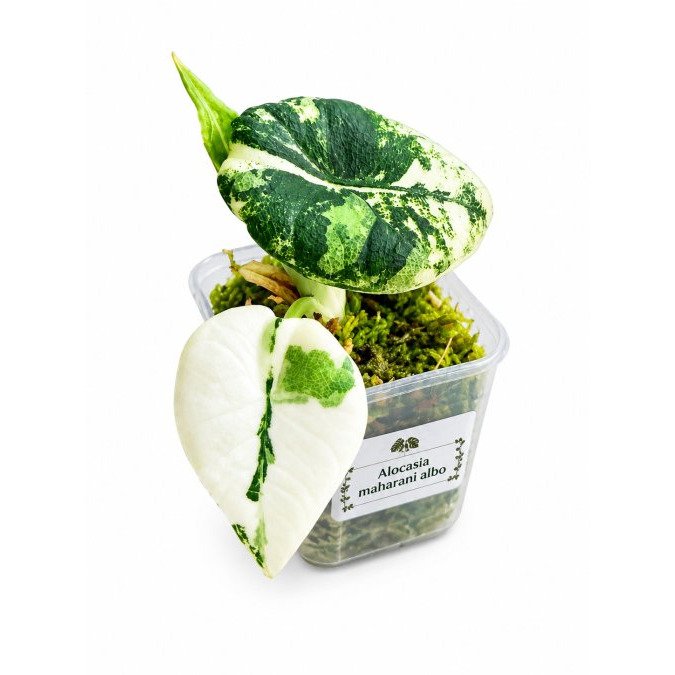
- Sectoral variegation, a wedge or block of the leaf is fully white or cream, with a hard edge against the green. Sectoral patterns are striking but less predictable, and a sectoral plant can throw a fully white leaf if the variegated sector lines up with the growth point.
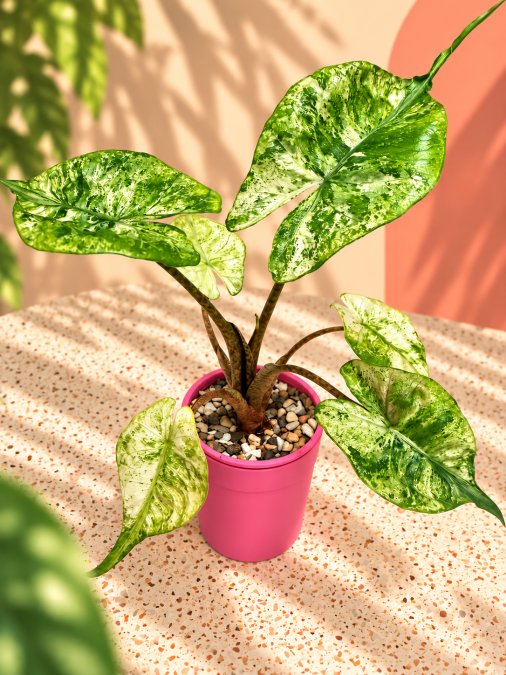
- Mosaic or marbled variegation, irregular splashes across the leaf. This is the most variable form, and the one most likely to shift pattern from leaf to leaf.
A vein-variegated Frydek has more chlorophyll per leaf, so it tolerates slightly lower light; a heavily sectoral or mosaic plant has less photosynthetic area and needs the brighter end of the range.
Frydek specifics that differ from general Alocasia care
Frydek is marginally more sensitive to overwatering than many cousins. Check the top 1-2 cm of soil before watering, it should feel nearly dry.
Leaf spotting on Frydek is usually a humidity-plus-airflow problem, not disease, direct misting in a still room causes it.
How other variegated cultivars differ
The two other variegated Alocasia you'll most often see in Australian collections behave differently enough that one routine won't suit all three.
Alocasia Flemingiana Aurea, larger, more upright leaves than Frydek, with yellow-gold variegation. Because yellow sections still contain some chlorophyll, Aurea plants are more vigorous than white-variegated types and tolerate a wider light range.
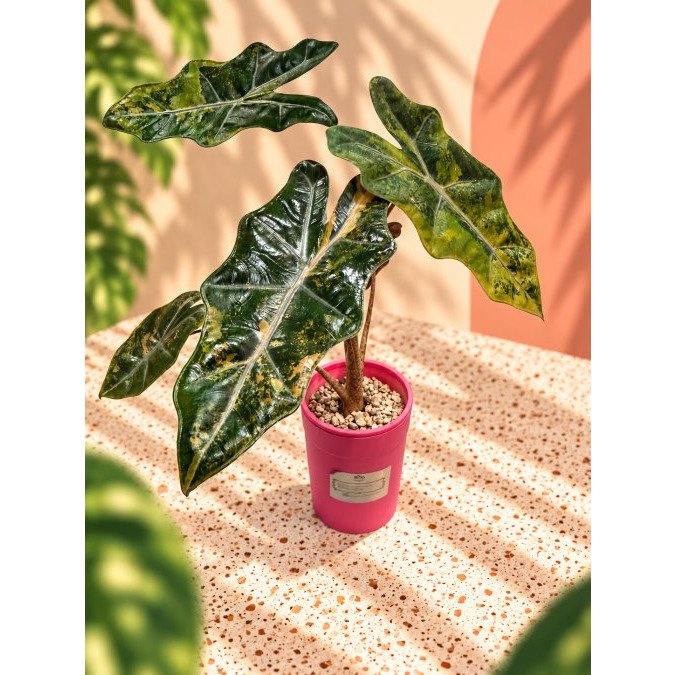
Alocasia Pseudosanderiana Aurea, narrower, arrow-shaped leaves and a more compact habit than Flemingiana. Its variegation tends to be more sectoral, so it's more prone to throwing an all-white or all-yellow leaf.

A quick comparison of what changes between cultivars
| Cultivar | Variegation colour | Typical habit | Light tolerance | Watering sensitivity |
|---|---|---|---|---|
| Frydek | White/cream | Compact, velvety leaves | Moderate indirect | Higher, dislikes wet feet |
| Flemingiana Aurea | Yellow-gold | Taller, upright | Wider range | Moderate |
| Pseudosanderiana Aurea | Yellow-gold | Compact, arrow-shaped | Brighter end | Moderate |
What stays the same across all three
Alocasia Flemingiana Aurea Variegated – Established Plant | Exact Plant 🌿💛 →
Regardless of cultivar, three things don't change: bright indirect light for 12-14 hours daily, a chunky airy mix, and warm humid conditions with good airflow.
How to Acclimate Alocasia After Arrival
When your variegated Alocasia arrives from us, it's been through interstate transport, temperature changes and reduced light, enough to stress even hardy plants. Acclimation takes 2-4 weeks.
For the first week, place it in a warm spot with moderate indirect light, not the brightest window yet, so it recovers without the shock of sudden bright light.
Keep soil evenly moist but not wet, the plant is recovering, not growing, so it needs less water than an established plant but consistent moisture.
By week two, move it gradually closer to its permanent spot over 3-5 days. If leaf burn (brown, papery patches) appears, step back and increase light more slowly.
After 2-4 weeks, with new growth and stable leaves, shift to your regular watering, humidity and light routine.
Acclimation is not the time to repot. Even if soil looks dense, wait until week 3 or 4 and only repot if the plant is thriving and showing active growth. Repotting during acclimation stresses plants further. ::: Establishing this initial stability is essential before you attempt other maintenance tasks like pruning indoor plants to encourage healthier growth cycles.
Troubleshooting Common Issues
Most variegated Alocasia problems come down to light, moisture, airflow or pests.
All-white or nearly all-white new leaves
This is the question collectors ask most, and the answer depends on how much green the rest of the plant has.
A run of all-white leaves is different.
Before pruning, count the green leaves. Four or more healthy green leaves means it can tolerate losing one or two white ones.
Yellow leaves with soft or mushy stems
Root rot, almost always. Stop watering, unpot, rinse the roots and cut away anything black, brown or mushy with sterilised snips.
Yellow leaves with firm stems and green veins
Usually overwatering without rot, or a nutrient deficiency. If the soil is consistently wet, back off watering.
Brown, papery patches on leaves
Leaf scorch from direct sun or a grow light too close. Move the plant back 15-20 cm or diffuse the light with a sheer curtain.
Brown leaf tips
Low humidity or inconsistent watering, often both. Raise humidity to 60-80% and check soil moisture regularly rather than watering on a fixed schedule.
Leaves curling or drooping
Check the soil first. Bone dry means underwatering, water thoroughly and drain.
Slow or stalled growth
Work through light duration (12-14 hours), temperature (above 18°C, ideally 20-28°C), humidity (above 50%, ideally 60-80%), then feeding.
Pests
Variegated Alocasia attract the same pests as any aroid, but variegated tissue is more vulnerable because it's already stressed.
- Spider mites, fine webbing underneath leaves and stippled yellow speckling on top; they thrive in dry, still air. Isolate, rinse the leaves thoroughly (undersides included), and treat with neem oil or insecticidal soap every 7 days for 3 weeks. Raise humidity and airflow.
- Thrips, silvery streaks, tiny black specks (frass) and sometimes distorted new growth. Harder to kill than mites: isolate, remove badly affected leaves, and treat with a product labelled for thrips, rotating between two active ingredients to avoid resistance. Repeat weekly for at least 4 weeks.
- Mealybugs, white cottony clusters in leaf axils and along stems. Remove with a cotton bud dipped in methylated spirits, then treat the whole plant with insecticidal soap. Check weekly for a month.
- Scale, brown or tan bumps on stems and leaf undersides. Scrape off gently, then treat with horticultural oil or insecticidal soap.
Always follow the product label. Never treat a plant in bright direct light, oil-based products can burn leaves.
Fungal issues
Black or brown spots with a yellow halo, especially in cool humid conditions with poor airflow, usually mean fungus.
Before changing anything, isolate the variable. Most variegated Alocasia problems trace back to light duration, soil moisture, airflow or pests. Change one thing at a time and give the plant 2-3 weeks to respond, changing everything at once makes it impossible to know what worked.
Frequently Asked Questions
How often should you water a variegated Alocasia?
Water when the top 2-3 centimetres of soil feel dry to the touch, usually every 7-10 days during the growing season. Check soil moisture before watering rather than following a fixed schedule. Variegated Alocasia prefers evenly moist but not waterlogged soil. Reduce watering in winter when growth slows. Overwatering is the most common reason variegated Alocasia develops root rot and loses leaves.
Why is my variegated Alocasia losing leaves?
Leaf loss typically signals overwatering, poor drainage, or sudden environmental change. Check roots for soft, brown tissue indicating rot. Ensure your soil drains well and you're allowing it to dry slightly between waterings. Variegated Alocasia also drops leaves if moved abruptly between different light or humidity conditions. After arrival from a grower, acclimate your plant gradually to your home environment over 2-3 weeks.
How much light does a variegated Alocasia need?
Variegated Alocasia thrives in bright indirect light for 12-14 hours daily. Place it near an east or west-facing window with a sheer curtain, or use a grow light positioned 30-60 centimetres above the plant. Variegated varieties actually need more consistent light than solid-green Alocasia because chlorophyll loss in white or pale areas means less photosynthetic capacity. Too little light causes weak growth and may cause variegation to fade.
Can variegation revert on Alocasia, and how do I prevent it?
Yes, variegation can shift between leaves or fade over time, especially under low light. This is natural and doesn't mean the plant is failing. Ensure consistent bright indirect light to support chlorophyll production in variegated sections. Feed with a balanced, diluted fertiliser during the growing season to support healthy leaf development. Each new leaf may show different variegation patterns, which is why collectors value exact-plant listings showing the actual specimen you're buying.