 listicle
Top Variegated Alocasia Varieties for Indoor Collections
Table of Contents
- Why Variegated Alocasia Varieties Dominate Indoor Collections
- Variegated Alocasia Varieties Worth Growing Indoors
- Variegated Alocasia Care: Light, Water and Aroid Mix Basics
- Alocasia Frydek Care for Variegated Forms
- Alocasia Variegation Stability: Reversion, Rhizomes and Corms
- Alocasia Pests and Diseases to Watch Indoors
- Choosing and Buying Variegated Alocasia
- Frequently Asked Questions
Last Updated: October 9, 2026
Why Variegated Alocasia Varieties Dominate Indoor Collections
Variegated Alocasia have become the centrepiece of serious indoor collections. At Obsessed With Aroids, we've watched demand shift from "any healthy Alocasia" toward plants with genuine genetic character: stable sectoral patterns, unusual colour breaks and traceable provenance.
The catch: variegation is a lottery, not a guarantee. Two plants from the same mother can throw completely different patterns, and a stunning leaf today says little about the next.
Variegated Alocasia Varieties Worth Growing Indoors
The best variegated Alocasia for indoor collections combine manageable size, tolerant growth and strong leaf pattern. Here's what we'd build a collection around.
| Variety | Variegation Type | Starting Price | Best For |
|---|---|---|---|
| Flemingiana Aurea | Yellow-gold aurea | $29 corm / $99 plant | First variegated purchase |
| Ninja Tricolour | Green, mint and cream | $69 | Compact shelves |
| Pseudosanderiana Aurea | Yellow-gold aurea | $119 | Collector display |
| Pink Dragon Albo | Creamy-white albo | $99 | Pink-stem lovers |
| macrorrhizos 'Black Stem' Albo | White albo | $89 corm | Statement floor plants |
| Amazonica Pink | Soft pink | $100 | Dark foliage contrast |
| Stingray Pink Alb | Pink, cream and green marble | $479 | Serious collectors |
Alocasia Flemingiana Aurea Variegated
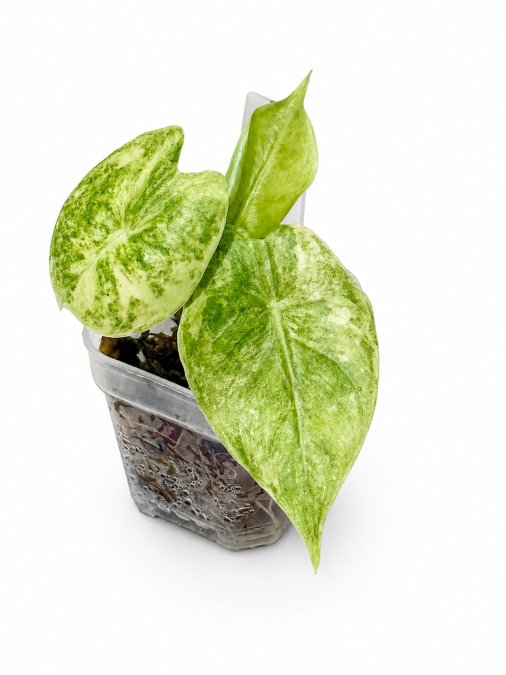
Flemingiana Aurea is where most collectors should start. It's compact, forgiving, and the yellow-gold aurea pattern reads clearly even on juvenile leaves. We offer both a corm-grown Flemingiana Aurea at $29 and an established plant at $99, so you can choose between watching a corm push its first leaf or skipping ahead to a plant already showing multiple patterned leaves.

Alocasia Ninja Tricolour Variegated
Compact velvet foliage with deep green, mint and cream on one leaf. The Ninja Tricolour is one of the few variegated Alocasia that genuinely suits a shelf rather than a floor, and at $69 for an established, rooted plant it's a solid entry into tricolour genetics.
Alocasia Pseudosanderiana Aurea Variegated
Pseudosanderiana Aurea is a rare collector Alocasia with strong yellow-gold and green aurea variegation and multiple active leaves. Ours are corm grown and established, priced at $119. Its heavier foliage texture makes the aurea contrast pop under indoor lighting.
Alocasia Pink Dragon Albo Variegated
Pink Dragon Albo pairs the variety's characteristic pink petioles with creamy-white albo variegation. We sell this as a corm-grown juvenile at $99, corm-grown, not tissue culture. Juvenile albo plants can shift pattern dramatically as they mature, so expect change.
Alocasia macrorrhizos 'Black Stem' Albo Variegata
This is the big one, literally. Dark stems plus white albo foliage make 'Black Stem' a statement plant for a bright corner. We list the corm at $89, already showing active growth. It grows large, so it's not a shelf plant, and needs more light than the compact varieties to keep pattern strong.
Alocasia Amazonica Pink Variegated
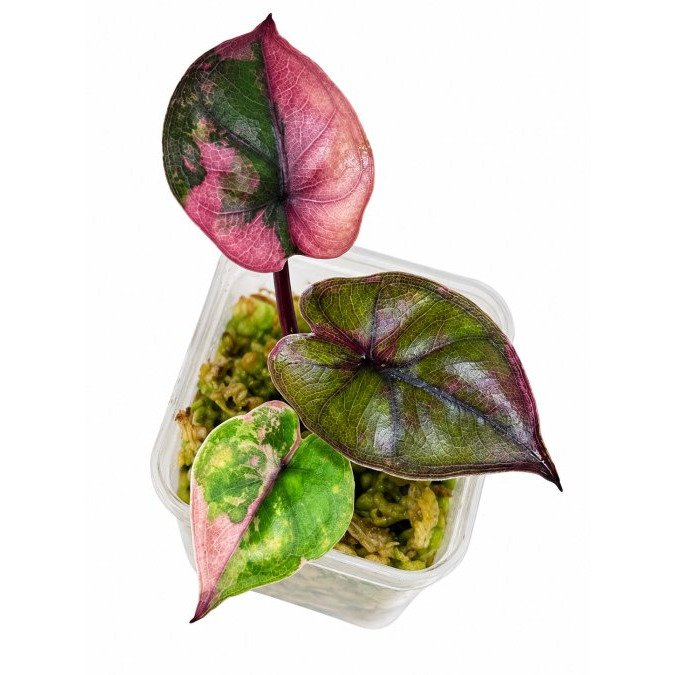
Amazonica Pink brings soft pink colouring through dark, arrow-shaped foliage. At $100 for a corm-grown, established plant, it's a genuinely interesting grow-on project. Note this is Amazonica, not Polly, which matters if you're chasing specific leaf morphology rather than a lookalike.
Alocasia Stingray Pink Alb Variegated
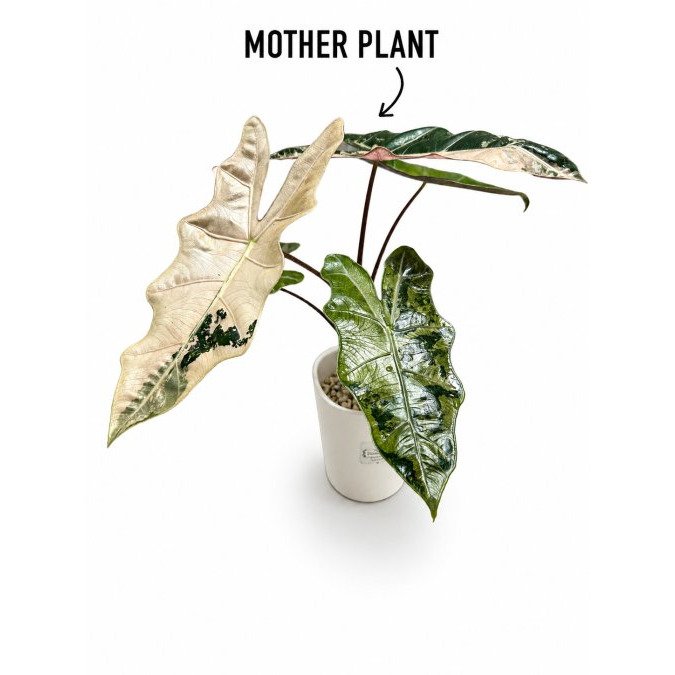
The Stingray Pink Alb is the rarest plant on this list, priced at $479 for a single corm. The mother plant throws distinctive Stingray-shaped foliage combined with pink, cream, pale green and deep green marbling. We only list one corm at a time, if you want it, don't deliberate.
Variegated Alocasia Care: Light, Water and Aroid Mix Basics
Variegated Alocasia care starts with light, because white and cream tissue carries no chlorophyll and can't photosynthesise. Give variegated plants bright indirect light, more than an all-green Alocasia, but never harsh midday sun, which scorches pale patches first. An east-facing window with a sheer curtain, or a spot a metre back from a north-facing window, suits most indoor collections. With grow lights, aim for a consistent photoperiod rather than blasting intensity; steady light supports steadier pattern expression.
A substrate recipe built for variegated roots
This is where variegated Alocasia actually live or die. Pale tissue photosynthesises less, so the plant has less energy for root repair, and a mix that stays wet too long is a bigger risk here than on a green Alocasia.
A mix that works well indoors:
- Orchid bark (medium grade), roughly 40% by volume. Provides structure and air pockets.
- Perlite, roughly 25%. Keeps the mix open and drains freely.
- Coco coir, roughly 25%. Holds moisture without compacting.
- Sphagnum moss, roughly 10%. Buffers moisture and supports fine root hairs.
- A handful of horticultural charcoal, optional, but helps keep the mix sweet in humid enclosures.
Adjust by season. In a warm, bright room over summer, push the coir slightly higher; in a cool room over winter, push bark and perlite higher and let the mix dry faster.
Watering without a schedule
Water when the top few centimetres of substrate feel dry, not on a fixed schedule. Alocasia hate sitting wet, and variegated types are no more forgiving than green ones.
Water the substrate, not the foliage. Velvet-leaf varieties in particular resent water sitting on the leaf surface, which invites fungal problems.
Humidity and airflow
Variegated Alocasia appreciate humidity in the 60-70% range, but steady beats extreme. A humidifier on a timer, or a grouped collection on a pebble tray, is usually enough. Airflow matters just as much, stagnant humid air grows fungus, not humidity itself. A small clip fan on low, moving air around the collection without blowing directly on leaves, does more than chasing a specific humidity number.
Feeding through the growing season
Fertilise lightly and regularly during the growing season, a diluted balanced feed every few weeks supports new leaf production without pushing soft, weak growth. Cut back to almost nothing over the cooler months. Overfeeding a variegated plant doesn't increase variegation; it just pushes soft growth that's more attractive to pests.
If you're building a collection and want plants that have been grown under these conditions, our variegated Alocasia collection lists what's currently available.
Alocasia Frydek Care for Variegated Forms
Alocasia Frydek care follows the same principles as any velvet-leaf Alocasia, with one addition: variegated Frydek forms need more light to keep their pattern from fading to plain green.
Frydek's velvety leaf texture is beautiful and also a liability. Water sitting on velvet leaves invites fungal problems, so water the substrate, not the foliage. Keep humidity steady rather than extreme, avoid misting leaves directly, and feed lightly through the growing season, cutting back over the cooler months.
Alocasia Flemingiana Aurea Variegated – Established Plant | Exact Plant 🌿💛 →
Alocasia Variegation Stability: Reversion, Rhizomes and Corms
Alocasia variegation stability is the question every collector eventually asks, and the honest answer is that no seller can guarantee it. What we can do is explain the mechanism, so you can read your own plant instead of guessing.
Why variegation is chimeric, not fixed
Variegation in Alocasia is chimeric. A growing point contains distinct cell layers, an outer layer that becomes epidermis, a middle layer that becomes the bulk of the leaf tissue, and an inner layer that feeds the core. In a variegated plant, some of those layers carry cells that can't produce normal chlorophyll.
Reading a growth point before you cut
If a plant reverts, don't treat it as broken. Look at where the newest leaf emerged.
When you cut back, cut to a node or eye below variegated tissue, not just below the green leaf. Cut into green tissue and the new shoot will usually come back green, the single most common mistake collectors make when trying to 'reset' a reverted plant.
Propagating without losing the pattern
Alocasia propagate in two main ways: by division of the rhizome, and by corms produced at the base of the plant. Both can carry variegation, but neither guarantees it.
Corms. A corm from a variegated mother carries that mother's genetics, but expression still varies.
Tissue culture. Tissue-cultured variegated Alocasia can behave unpredictably as they mature, because the chimeral layers may not be evenly represented in the cultured tissue.
What we tell buyers
We say plainly on our listings: future variegation may increase, decrease or revert. That isn't a hedge, it's an accurate description of how chimeras work.
What you can control is the environment.
If you want to go deeper on reading growth points and propagating variegated aroids, our aroid care guides walk through the process step by step.
Alocasia Pests and Diseases to Watch Indoors
Alocasia pests and diseases indoors usually come down to three culprits: spider mites, mealybugs and root rot.
Root rot is the bigger risk and almost always a watering problem. Yellowing lower leaves, soft stems and a sour smell from the substrate are the warning signs.
Prevention beats treatment. Quarantine new plants for a couple of weeks, inspect leaf undersides weekly, and keep humidity steady without letting the substrate stay wet.
Choosing and Buying Variegated Alocasia
Buying variegated Alocasia online comes down to provenance and honesty.
Corm-grown and tissue culture plants are genuinely different. Corm-grown plants are propagated from a mother plant's corm, so they carry that plant's genetics and grow on with real character.
We're ICA accredited for interstate plant movements, which lets us prepare and certify eligible plants for movement in line with applicable biosecurity requirements. Shipping runs Australia-wide excluding NT, with additional biosecurity requirements applying to WA and TAS.
Frequently Asked Questions
Which variegated Alocasia is best for beginners?
Alocasia Ninja Tricolour Variegated is a good starting point because it stays compact and develops tricolour variegation on velvet foliage. Alocasia Flemingiana Aurea Variegated is another manageable option, with yellow-gold aurea variegation on established leaves. Both are corm-grown rather than tissue culture, so they tend to establish well indoors. Beginners should still expect some leaf loss during acclimatisation and should keep humidity steady while new growth appears.
Why is my variegated Alocasia losing its variegation?
Variegation in Alocasia is genetically variable, so a plant can produce leaves with more green, less pattern, or full reversion over time. This is normal and not a sign of poor care. Light levels, fertilisation schedule and root health influence how much colour each new leaf shows, but no grower can guarantee future variegation. If a leaf comes out fully green, you can leave it to support the plant or remove it if you want to encourage variegated growth on the next leaf.
Do variegated Alocasia need more light than green varieties?
Variegated leaves contain less chlorophyll, so they usually need brighter conditions to photosynthesise efficiently. Bright indirect light works well indoors, but harsh afternoon sun can scorch pale sections of the leaf. A spot near an east or filtered north-facing window is often ideal. If new leaves emerge small and pale, more light may help. If leaf edges brown and crisp, the plant is getting too much direct sun.
How can you tell whether an Alocasia is genuinely variegated?
Genuine variegation appears as stable colour patterns in the leaf tissue, such as sectoral stripes, splash patterns or marbled sections, not as damage or nutrient deficiency. Look for consistent colouring across multiple leaves and check that the seller shows the exact plant. Ask whether it is corm-grown or tissue culture, since corm-grown plants come from a known variegated mother plant. Obsessed With Aroids lists exact plants with photos so you can see the actual specimen before buying.
Variegated Alocasia reward patience more than any other plant in the collection. They're variable, occasionally stubborn, and completely worth it when a new leaf unfurls with a pattern you've never seen before. If you're ready to add one, browse our Alocasia collection for exact-plant listings, corm-grown stock and ICA-accredited shipping Australia-wide. Get started with Obsessed With Aroids and grow something genuinely uncommon.